4.9/5 from 299 customers Grayanotoxin figures published for every harvest Free shipping · 4 to 5 days to the US

Himalayan rhododendron honey

What is mad honey?


A dark reddish honey made by Himalayan giant honeybees feeding on rhododendron nectar. The flower's own grayanotoxins carry through into the comb, which is what separates this honey from every jar on a supermarket shelf.

14 min read Updated

Wild mad honey comb harvested from a Himalayan cliff in Nepal
Every batch lab testedThird-party grayanotoxin figures and DFTQC certification, published before a jar ships
The bee
Apis laboriosa, the world's largest honeybee, nesting on open cliff faces
Altitude
8,200 to 14,000 ft across the Lamjung region and the wider Annapurna hills
Active compound
GTX I and GTX III, produced by the rhododendron, not added
Harvest
Twice yearly, spring for strength and autumn for a gentler jar

The short answer

Mad honey is a dark reddish honey made by bees that feed on rhododendron nectar, which leaves it carrying natural compounds called grayanotoxins. It comes mainly from the Himalayan foothills of Nepal and the Black Sea coast of Turkey.

Mildly relaxing in small amounts and genuinely toxic in large ones, which is why it has been treated as medicine and ritual for more than two thousand years rather than as something to spread on toast.

Plenty of myths travel with it. Crazy wild honey, hallucination honey, cliff honey. The reality sits somewhere quieter than the nicknames suggest, and it depends almost entirely on the amount taken.

Origin

Where does mad honey come from?

Only a few places on earth produce it in any real quantity, and the reason has nothing to do with tradition. It comes down to which flowers grow where.

The Himalayan foothills of Nepal

Bees make mad honey wherever grayanotoxin-bearing rhododendrons grow thickly enough that they have almost nothing else to visit. In Nepal that means the middle hills across Lamjung, Kaski, Manaslu, Langtang and the wider Annapurna region, at altitudes where rhododendron forest takes over the slopes.

Honey hunters have worked these cliffs for centuries without harvesting equipment, climbing faces between 8,200 and 13,100 feet. Before any rope comes out there is a puja, an offering made to the cliff and to the spirits believed to watch over the bees, asking permission and safe passage. Flowers, rice, and in some places an animal offering, depending on local custom.

It would be easy to read that as decoration. It is not. The ritual frames the harvest as an exchange rather than a taking, and that same understanding sits behind the practical limits on how much comb comes off a cliff and how often anyone returns to it.

Traditional harvesting is now fading. Young people from hunting villages leave for work, to Kathmandu or to the Gulf and Malaysia, and an apprenticeship chain breaks the moment a generation goes missing. What remains is a shrinking group of hunters, most of them middle aged or older, carrying knowledge that was never written down.

Apis laboriosa, the Himalayan giant honeybee

The bee behind Nepali mad honey is the largest honeybee in the world, with workers reaching around three centimetres. Nobody keeps it in a box. The honey comes from single open combs built on exposed cliff faces, sometimes hundreds of metres above the valley floor, and the colonies migrate with the seasons between high and low ground.

That biology explains both the price and the existence of honey hunting as a way of life. There is no farming this bee. The honey has to come off the cliff by hand, the way it always has. Turkish honey from managed Apis mellifera hives is a genuinely different product, and the gap in potency, flavour and cost is wide enough to matter at the point of purchase.

Nepalese cliff honey and Turkish deli bal

Both are sold as mad honey and both are genuine, but they are different products from different bees, and the gap matters at the point of purchase.

The two commercial sources of mad honey, side by side.
 Nepalese cliff honeyWhat we sellTurkish deli balBlack Sea coast
The beeApis laboriosa, wild, cannot be hivedApis mellifera, managed hives
Where it growsOpen cliff faces, 8,200 to 14,000 ftManaged apiaries near rhododendron stands
PotencyHigher, and highest at spring bloomGentler, with a wider margin for error
HarvestBy hand, from rope ladders, twice yearlyConventional beekeeping
SuitsAnyone wanting the full character, dosed carefullyFirst-timers who want a very forgiving dose curve

Rhododendron, the flower behind the honey

Nepal is a rhododendron country. More than thirty species grow across its hills, and the best known is Rhododendron arboreum, the national flower, called lali gurans locally. It grows as a tree rather than a shrub and turns entire hillsides deep red in bloom.

Those stands sit roughly between 1,200 and 3,600 metres, densest around 2,000 to 3,000 metres, with hardier species climbing past 4,000. Flowering follows elevation, starting in the lower forests around late February and working upward through April and May. That band is exactly where Apis laboriosa nests, so when the bloom is this thick the bees have little else worth visiting and the honey comes back close to monofloral.
30+Rhododendron species in NepalToxin load differs sharply between them, which is why district and altitude belong on the label.
3 cmWorker bee body lengthApis laboriosa is the largest honeybee on earth and cannot be kept in a managed hive.
2,000 mDensest bloom elevationFlowering climbs the hillside from late February through May, following the warmth upward.

The mechanism

What is grayanotoxin?

Everything mad honey is known for traces back to a single interaction between one plant compound and one type of cell channel.

Grayanotoxin is a diterpenoid neurotoxin produced by plants in the Ericaceae family, which covers rhododendrons, azaleas, mountain laurel and pieris. More than a dozen forms have been identified, and a small handful account for most of the effects seen in humans. The name traces back to Leucothoe grayana, a Japanese shrub in the same family, from which the compound was first isolated.

Grayanotoxin is not an additive, a contaminant, or something that develops in the jar over time. It is a defensive compound the rhododendron produces in its own tissue, and the bees do nothing more than carry it from flower to comb.

Taken in the right amount it produces calm. Taken beyond that amount it becomes toxic. There is no version of this honey where the dose does not matter.

How it works, in three steps

It binds to open sodium channels

Nerve and muscle cells fire by opening sodium channels to let sodium in, then closing them to reset. Grayanotoxin attaches to those channels while they sit open, and it does not let go.

The channel cannot close

Held open, the cell stays flooded with sodium and stuck in a depolarised state. It loses the ability to reset and fire normally, which is what separates grayanotoxin from compounds that simply block a channel outright.

Vagus nerve overstimulation follows

That sustained depolarisation drives the vagus nerve, which regulates heart rate, blood pressure and digestion. The slowed pulse, dropped blood pressure, dizziness and nausea all trace back to this single point.

Cliff to jar

How is mad honey harvested?

Nothing on that cliff was bought for the job. The kit is bamboo, rope and improvisation, and the timing is set by the bloom rather than by a date on a wall.

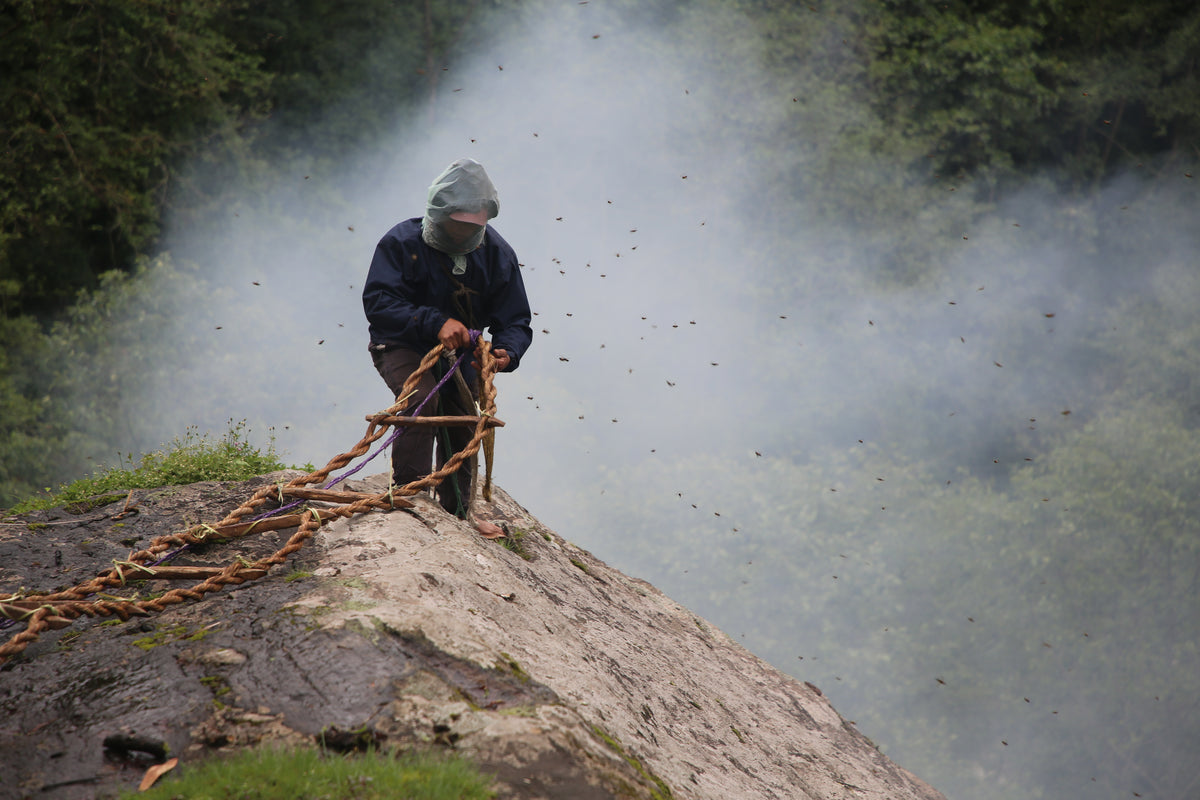
Honey hunters harvesting wild Apis laboriosa comb from a cliff face in Nepal
Cliff harvest in the Nepal hills. Comb is cut by hand from a bamboo ladder and lowered by basket to the ground team.

Timing is everything

Harvesting happens twice a year, guided by the bloom and the lunar calendar. The spring harvest runs from late April into early summer, and the autumn harvest from September into October.

The two are not interchangeable. Spring honey, taken at the height of the rhododendron bloom, carries the heavier grayanotoxin load and is noticeably stronger. Autumn honey is gentler, because by then the bees have been working a much wider mix of flowers.

The climb

The climber goes down the ladder to hive level, often with a hundred metres or more of open air underneath, and works one-handed while bracing against the rock. Comb comes off in sections, gets guided into the basket, and is lowered to the ground team.

The pale brood section of the comb, the part holding larvae, gets separated out and is not honey at all. What everyone is there for is the darker, honey-filled section. Accidents do happen. This is hand-made rope, real height, and thousands of extremely annoyed bees, with nothing resembling modern safety equipment anywhere in sight.

From cliff to jar

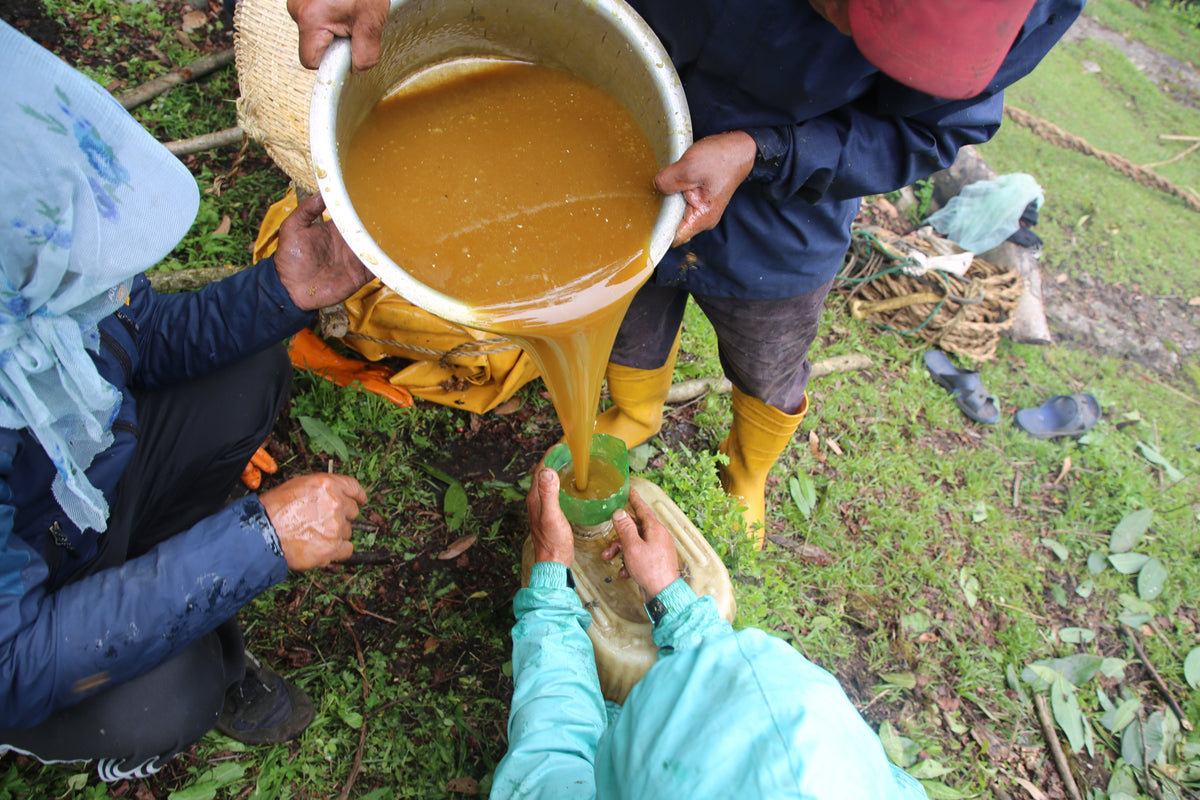
Comb goes down to the village, where honey is strained from wax using gravity and simple filtration. Good practice keeps it raw and unheated, because heat destroys the enzymes and aromatics that make the honey worth its price in the first place.

From there it travels to Kathmandu for laboratory testing, which is the step that separates a verified jar from an unverified one. Packaging, labelling and quality testing all happen at the Best Mad Honey production facility before shipping worldwide.

Tools of the trade

Five things, none of them made for the job. This is the entire kit that stands between a hunter and a two-hundred-foot drop.

01Bamboo rope laddersHand-woven, single use

Split by hand into thin strips and braided into rope, then anchored at the top of the cliff and dropped down the face. A ladder is made for the harvest it is needed for, and the weaving is a skill in its own right, taught long before anyone is allowed near an edge.

02TangosBamboo, up to 4 m

Long poles, one with a blade lashed to the end for cutting comb at arm's length, another for steadying the basket while it fills. They let a hunter work a hive he cannot safely reach, which is most of them.

03BasketsLowered on a second line

Woven bamboo, sent down on its own rope so the cut comb never has to be carried by the person on the ladder. Full, it is lowered to the team waiting at the base.

04SmokeGreen vegetation, lit below

Damp foliage burnt at the foot of the cliff sends smoke up across the hives. It clears the bees off the comb and keeps them scattered long enough for the cut, and it is the only thing on this list that protects the hunter at all.

05Hooks and sticksFor holding position

Used to brace against the rock and stop the ladder swinging while both hands are busy. Protective gear is minimal or absent. Most hunters work in ordinary clothes, and a net over the face is as much as anyone wears.

Batch variance

Why strength varies from batch to batch

There is no fixed potency, and this is the thing most first-time buyers underestimate.

Season

Spring honey is cut while the rhododendron bloom is at its peak, when the bees have almost nothing else worth visiting. Autumn honey is taken once that bloom has faded and the foraging range has widened to a mix of flowers. The same cliff, harvested five months apart, can differ threefold in grayanotoxin.

Altitude and species mix

More than thirty rhododendron species grow across Nepal, and their toxin loads are not remotely equal. Which ones dominate depends on elevation, so a hive at 9,000 feet and one at 13,500 feet are drawing on different plants entirely. This is why a named district and altitude band tell you more than the word Himalayan on a label.

Flower density

A honey is only as concentrated as the foraging range is pure. Where rhododendron blankets the hillside, the comb comes back close to monofloral and the grayanotoxin is high. Where the bees can reach other flowers, the result is diluted long before anyone touches it.

Weather that year

The bloom is short, and a run of rain or an early warm spell shortens it further. When that happens the bees spend more of the window on whatever else is flowering, and the harvest comes in milder than the previous year from the identical cliff. It is the reason no producer can promise a fixed potency season after season.

Handling after harvest

Comb from several cliffs is usually strained and combined, which evens out the extremes rather than leaving one unusually strong batch in circulation. That is precisely why lab-tested commercial honey behaves more predictably than a jar bought loose at a village market, where a single comb can sit far above or below the average with nothing to warn you.

What that looks like in numbers

Measured grayanotoxin I readings for the three current harvests, plotted on one scale. The gap between the mildest and the strongest is roughly fivefold.

Autumn HarvestGTX I 3,869.60 · GTX III 276.15

Mild. Where first-time users start.

Spring HarvestGTX I 11,409.56 · GTX III 2,765.67

Full strength, the classic character.

Rare HarvestGTX I 19,296.17 · GTX III 5,356.91

Highest reading, for experienced users only.

0Grayanotoxin I, µg/kg20,000

What this means for a buyer. Each harvest differs in taste and potency because each comes from a different season and a different band of cliff. That is a property of wild honey, not a defect. Figures for every harvest are published in the full lab reports, so the strength of a jar is known before it is opened rather than discovered afterwards.

Traditional use

Mad honey benefits and traditional uses

In Nepal and Turkey, small amounts have been taken for generations against a fairly consistent list of complaints: digestive trouble such as gastritis and peptic ulcer, high blood pressure, joint and muscle pain, seasonal illness, and use as an aphrodisiac. In Nepali households it often comes out in the cold months, stirred into warm water or tea.

Deep relaxation

This is what most people describe first, and it is physical before it is mental. The grayanotoxins from high-altitude rhododendron are traditionally credited with settling the nervous system, loosening tight muscles and quieting a mind that will not stop turning over. In Nepal it is taken in the evening rather than the morning for exactly that reason.

Traditionally takenHalf to one teaspoon, evening, after a light meal

Digestive comfort

One of the oldest recorded uses on both sides of the trade, in Nepal and along the Turkish Black Sea coast. Households have long reached for a small amount against gastritis, ulcer pain and general stomach trouble. It is a folk remedy rather than a treatment, but it is a remarkably consistent one across two regions that had little contact with each other.

Traditionally takenA small amount, stirred into warm water

Raw, so nothing is cooked out

Heat is what strips an ordinary supermarket honey of most of what made it interesting. Ours is never pasteurised and never heated to speed up filtering, so the antioxidants, polyphenols and active enzymes present in the comb are still present in the jar. It is also why the honey crystallises over time, which is a sign it is genuine rather than a fault.

Why it mattersUnheated and unblended, strained only for wax

Throat soothing

The most everyday use of all, and the one that needs no explanation. Thick raw nectar coats a sore throat the way processed honey does not, and across the Himalayan hills it comes out of the cupboard the moment the cold months arrive. Usually a spoonful in warm water or tea rather than anything more elaborate.

Traditionally takenA spoonful in warm water, cold season

Unrefined energy

Fructose and glucose straight from the comb, with none of the refining that ordinary table sugar goes through. That is not a claim about doing anything sugar does not, only that what is in the jar is what the bees put there. The flavour carries the same difference: floral and sharp rather than flatly sweet.

Why it mattersNothing added, nothing removed but wax

Worth knowing. These are traditional and customary uses recorded across Nepal and Turkey. They are not medical claims, and mad honey is not a treatment for any condition.

Mad honey is a food, not a medicine. Nothing on this page is intended to diagnose, treat, cure or prevent any disease. Anyone managing a health condition or taking prescription medication should speak to a doctor before trying it.

Effects, side effects and dosage

How much mad honey is safe?

The warning signs of too much are consistent and worth memorising before a jar is opened. Grayanotoxin overload is a real clinical event, not a bad mood.

Dosage by experience

Start here½ tsp2 to 3 g. Always start here to test sensitivity to a specific batch. Gentle physical warmth and light body relaxation.
Standard1 tsp5 g. Once the response to a batch is known, this is the usual amount for noticeable relaxation and mood elevation.
Daily ceiling1 to 1.5 tspPer 24 hours, never more. Beyond this risks grayanotoxin overload: dizziness, nausea, sweating and a drop in blood pressure.

Timing and conditions

  • When

    Mid to late evening, or a quiet weekend afternoon with no work, driving or heavy responsibilities. The effect is deep physical relaxation, so it lands best when sitting back is an option.

  • Stomach

    One to two hours after a light meal. An empty stomach makes the onset too sharp and can cause nausea, while a heavy meal delays absorption.

  • Onset

    Effects usually begin within 30 to 60 minutes and peak around 1.5 to 2 hours after consumption. The calm typically lasts 3 to 5 hours.

  • Golden rule

    Wait at least 90 minutes before considering more. A second dose taken too early is the most common cause of a bad experience.

If someone takes too much

Grayanotoxin overload is uncommon at the amounts above, and it resolves on its own in most cases. The signs are worth recognising all the same.

  • Dizziness or lightheadedness
  • Nausea or vomiting
  • Blurred vision
  • Heavy sweating
  • Tingling around the mouth or hands
  • A slow or irregular pulse
  • Weakness or unsteadiness

A slow or irregular pulse together with fainting warrants urgent medical attention. Grayanotoxin poisoning is treatable, and doctors should be told exactly what was eaten.

Not for everyone: heart conditions, medication, pregnancy

Do not take mad honey if any of these apply.

You have a heart condition, arrhythmia or a history of low blood pressure. You take calcium channel blockers, blood pressure medication or any drug affecting heart rate. You are pregnant or breastfeeding. You are under 18. Infants under one year should never have honey of any kind, because of the separate risk of infant botulism.

Anyone managing a serious ongoing condition should check with a doctor first. Mad honey should never be combined with alcohol, and a second dose should never be taken simply because the first has not been felt yet.

Keep the first-jar rules where you can find them

A one-page card with the dosage steps, timing rules and warning signs from this section, sent by email. Harvest notes follow when a new batch is tested, and nothing else.

  • Half, one and ceiling amounts for each harvest
  • The 90 minute rule and what to eat beforehand
  • Warning signs, and who should not take it
  • First notice when the spring harvest lands
One email with the card, then harvest notes a few times a year. Unsubscribe in one click.

Choose a harvest

Which mad honey variety is right for you?

Variety comes down to two things: the season it was taken and the flowers available at that altitude. Four harvests, four different jobs.

Find your harvest in two questions

Answer both and the right jar appears below. Nothing is sent anywhere.

Have you taken mad honey before?

How much do you want to commit to?

Your match

View this harvest
Grayanotoxin values in micrograms per kilogram. Full figures on the lab reports page.
Characteristics Autumn HarvestBest seller Spring HarvestMost popular Rare HarvestStrongest Try PackTrial size
Found in Himalayan cliffs, 8,200 to 13,100 ft High Himalayan cliffs, 8,200 to 11,500 ft Remote Himalayan cliffs, 13,500 to 14,000 ft Spring harvest honey in a 30 g pouch
Sensory profile Golden amber, smooth, light sweetness Deep reddish brown, rich floral sweetness Deep reddish, bold, earthy sweetness Same as spring harvest
Amount to consume 1 to 1.5 teaspoons daily ½ to 1 teaspoon maximum daily ½ to 1 teaspoon maximum daily ½ teaspoon, to test tolerance
Price 200g at $89
400g at $169
600g at $259
100g at $139
200g at $199
220g at $399 30g at $49
60g at $89
Best for whom First-time users establishing their tolerance Anyone wanting the classic mad honey character at full strength Experienced users who already know how they respond to spring harvest honey First-time buyers sampling before committing to a full jar
Grayanotoxin Mild
GTX I 3,869.60
GTX III 276.15
High
GTX I 11,409.56
GTX III 2,765.67
Highest
GTX I 19,296.17
GTX III 5,356.91
High, same as spring harvest
Shop Autumn Shop Spring Shop Rare Shop Try Pack

Questions

Still deciding? Start here.

The questions buyers ask most often before a first jar, answered plainly.

What does mad honey make you feel?

Taken in recommended amounts, most people report a warm, relaxing body sensation, mild lightheadedness and a gentle sense of calm. The main effects are easing bodily tension and soothing stress.

How much mad honey is safe to consume?

Mad honey gets its effects from naturally occurring grayanotoxins found in certain rhododendron flowers. For a first time with a strong potency harvest, start with half a teaspoon and wait at least 60 minutes to see how the body responds.

Why are the effects sometimes not noticeable?

Effects vary from person to person and from batch to batch. A lower sensitivity to grayanotoxins is one explanation, and a heavy meal beforehand is another, since it slows how quickly the effects appear.

Does mad honey expire?

Honey does not spoil in the usual sense, and mad honey kept sealed and cool lasts for years. Grayanotoxin content fades slowly over time, so a very old jar may be milder. Crystallisation is normal and is not spoilage.

What does mad honey taste like?

Sweet up front, then a distinctly bitter, sharp and slightly astringent finish, with a faint burn at the back of the throat in stronger batches. That bitterness is the most reliable everyday authenticity check available.

Can you cook with mad honey?

Tradition says eat it raw, off the spoon or stirred into a warm drink. Heat destroys the enzymes and aroma that justify the price, and it does not reliably remove grayanotoxin, so cooking neither improves the honey nor makes it safer.

Is mad honey the same as red honey?

Broadly yes. Red honey, cliff honey and Himalayan mad honey are common names for the same Nepali product, and the reddish colour comes from rhododendron nectar. Names prove nothing on their own, since anyone can print red honey on a label.

Is all rhododendron honey mad honey?

No. Grayanotoxin levels differ sharply between rhododendron species, and bees have to forage almost exclusively on the high toxin ones for honey to turn active. Most honey containing some rhododendron nectar is completely ordinary.

Is mad honey natural, or processed?

Genuine mad honey is raw, strained from wild comb and bottled without heating or additives, and the grayanotoxin comes from the flowers rather than being added. Adulterated products cut with ordinary honey do circulate, which is exactly what lab testing and named-district sourcing exist to rule out.

Limited each season

Real mad honey, straight from Nepal's cliffs

Stock of authentic Himalayan mad honey is limited every season. Whether the goal is gentle daily calm from the Autumn Harvest or peak-season potency from the Spring and Rare yields, every jar is lab tested and certified before it leaves Kathmandu.

Ships to 190+ countries via DHL and FedEx · Dispatched from Kathmandu within two business days

Autumn Harvest · $89Mildest jar · where most people start
Shop